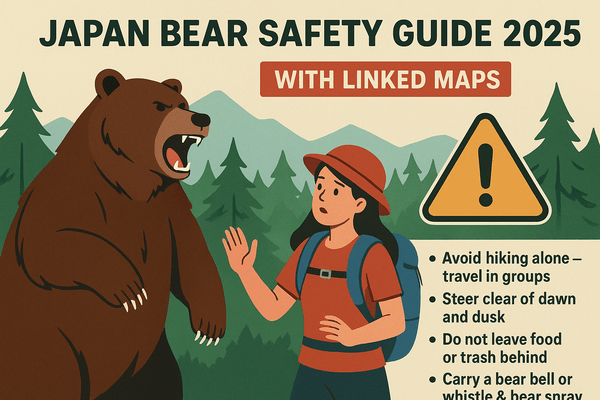
When most people imagine Japan, they picture neon lights, peaceful temples, or cherry blossoms in full bloom — not bears.
Yet in recent years, Japan has been facing an alarming rise in bear encounters, even in areas once considered safe.
News of bear attacks or bear collisions has become increasingly common, and residents in major cities like Sendai and Sapporo are growing anxious as bears are now frequently sighted even near urban neighborhoods.
News reports have shown bears wandering through small towns, crossing roads, and in some rare cases, attacking people.
The number of incidents reached a record high in 2025, and experts warn that the situation is likely to continue worsening.
What’s happening to Japan’s wildlife — and what should travelers know before venturing into its forests and mountains?
- Why Bear Encounters Are Increasing
- Tourist Safety Tips in Bear Areas
- Bear Maps of Japan
- Conclusion: Staying Safe While Enjoying Japan’s Wilderness
Why Bear Encounters Are Increasing
Experts point to several reasons behind this sudden surge.
One major factor is climate change, which has caused irregular acorn harvests — a key food source for bears before hibernation.
When the forest fails to provide enough, hungry bears wander into villages and farmlands searching for food.

Surprisingly, even in Tokyo, bears are commonly found in the mountainous western regions.
In fact, a bear that killed a cleaner at a hot spring in Kitakami, northern Japan, was later found to be severely underweight.
The animal measured about 1.5 meters in length and, according to local hunters involved in its disposal, weighed around 80 kilograms — unusually light for this time of year.
“It hadn’t accumulated the fat it would normally need for hibernation,” the hunters said, a tragic reminder of how changing ecosystems are pushing wildlife closer to human life.
At the same time, Japan’s rural population is shrinking rapidly. As more people move to cities, many mountain communities are left empty. Fields become overgrown, warning systems disappear, and the boundary between human life and wildlife slowly fades.
For bears, that means fewer reasons to stay away.
Tourist Safety Tips in Bear Areas
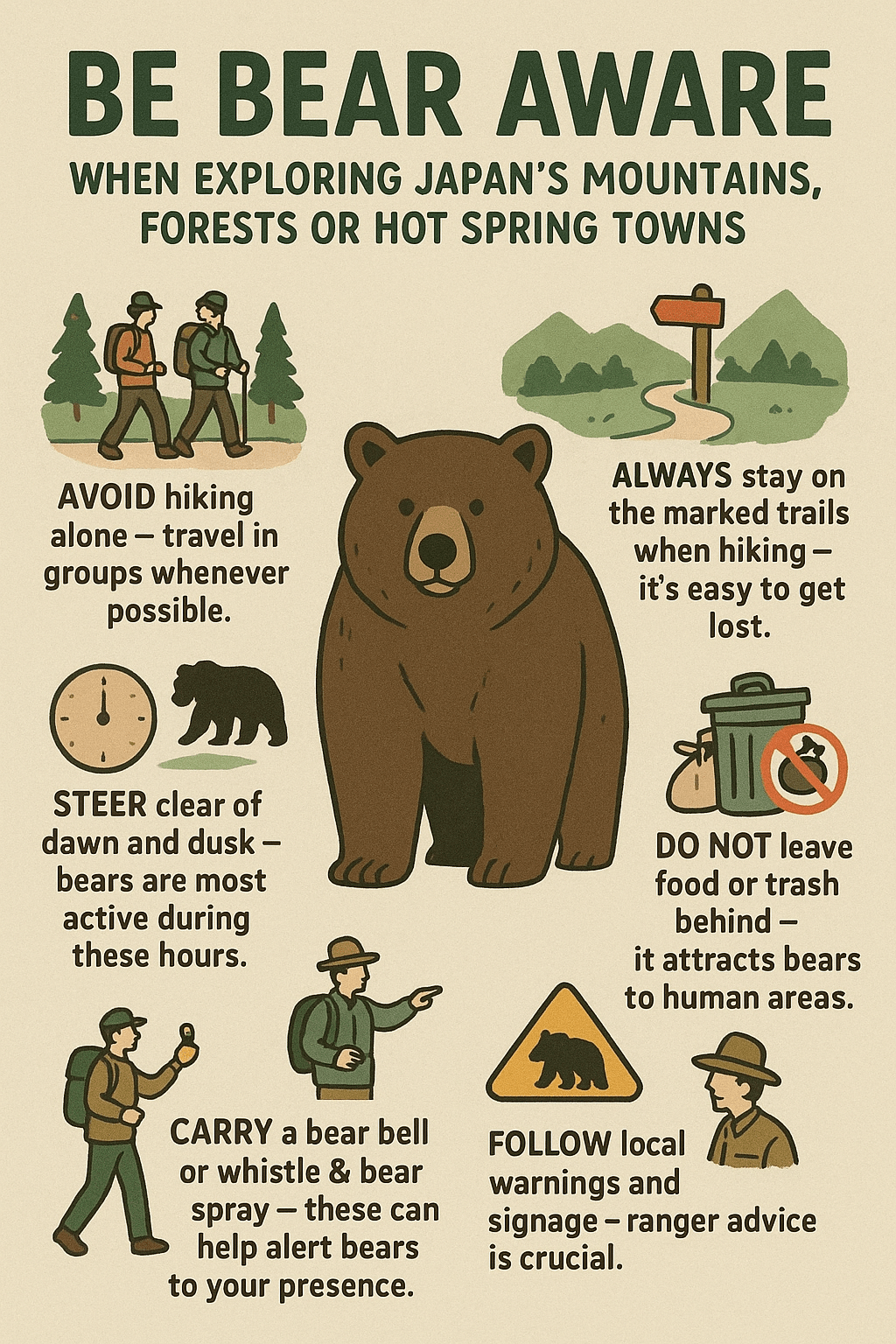
If you’re planning to explore Japan’s mountains, forests, or hot spring towns, it’s important to be aware of bear activity.
Bears are most commonly found in regions like Hokkaido, Tohoku, Nagano, and Yamanashi, but they can appear near hiking trails and even around some rural onsen towns.
Here are some practical tips to stay safe:
- AVOID hiking alone — travel in groups whenever possible.
- ALWAYS stay on the marked trails when hiking — It’s easy to get lost.
- STEER clear of dawn and dusk — bears are most active during these hours.
- DO NOT leave food or trash behind — it attracts bears to human areas.
- CARRY a bear bell or whistle & Bear spray — these can help alert bears to your presence.
- FOLLOW local warnings and signage — ranger advice is crucial.
If you encounter a bear:
- Back away slowly while keeping the animal in sight.
- Never turn your back and run — sudden movements can trigger an attack.
- Make noise or throw objects to deter the bear safely.
- Be extra cautious around cubs — mother bears are very protective and may attack if they feel their cubs are in danger.

By taking these precautions, you can enjoy Japan’s natural beauty while minimizing the risk of a dangerous encounter!
*Keep in mind that, as wild animals, bears may still attack even if you follow all these precautions.
Bear Maps of Japan
Here are bear sighting maps for each prefecture in Japan.
Unfortunately, there is no unified nationwide map, and most are in Japanese, but they are visualized and can be a useful reference.
Hokkaido
Aomori
Iwate
Miyagi
Akita
Yamagata
Fukushima
Ibaraki — No map. Very few sightings, but northern mountains require caution.
Tochigi
Gunma
Saitama
Chiba — No bear sightings so far.
Tokyo
Kanagawa
Niigata
Toyama
Ishikawa
Fukui
Yamanashi
Nagano — App-exclusive (iOS & Android)
Gifu
Shizuoka — No map.
Aichi — No map.
Mie
Shiga
Kyoto
Osaka
Hyogo — PDF Only.
Nara — No map.
Wakayama
Tottori
Shimane
Okayama — No map.
Hiroshima — No map.
Yamaguchi
Tokushima
Kagawa — No bear sightings so far.
Ehime — No bear sightings so far.
Kochi
Fukuoka — No bear sightings so far.
Saga — No bear sightings so far.
Nagasaki — No bear sightings so far.
Kumamoto — No bear sightings so far.
Oita — No bear sightings so far.
Miyazaki — No bear sightings so far.
Kagoshima — No bear sightings so far.
Okinawa — No bear sightings so far.
Conclusion: Staying Safe While Enjoying Japan’s Wilderness
While bears may be fascinating creatures, it’s important to remember that they are wild animals. There is no way to guarantee complete safety.
Travelers should always check local information, follow warning signs, and be aware of the areas they plan to visit.
That said, there’s no need to let fear stop you from enjoying Japan’s natural beauty. With proper preparation, knowledge, and caution, you can safely experience hiking trails, hot springs, and other mountain attractions.
Consider joining guided tours or consulting local guides, which can greatly reduce the risk of dangerous encounters.
By staying informed and taking precautions, you can enjoy Japan’s wilderness responsibly — appreciating its wildlife without putting yourself at unnecessary risk!

 Hirokitia