
Recently, headlines have been dominated by rising tensions in Russia and Gaza, sparking renewed debates about national security here in Japan. Whether it’s discussions about territorial disputes or the latest military maneuvers by neighboring countries, these developments serve as a stark reminder: despite our deepest hopes for peace, conflict is never far from the surface.
War is an unfortunate but enduring reality of human society. No matter how hard we try, it seems that conflict arises from issues that dialogue alone can’t always resolve. If eliminating war were truly possible, we would have achieved it by now.
The first recorded war in history, the Battle of Kadesh, took place over 3,000 years ago. Yet, despite the passage of millennia, war has never disappeared.
In Japan, many of us take immense pride in Article 9 of the Japanese Constitution, which renounces war. Especially notable is the second clause of Article 9, which prohibits Japan from maintaining an army, navy, or air force. That’s the reason why some argue that the Japanese Constitution is “the most thoroughly pacifist in the world“, and that “amending it would mean abandoning the principle of peace“.
But, should we consider the pursuit of eliminating war a delusion—an unrealistic and ultimately meaningless endeavor?
Unfortunately, the reality suggests that it might be.
Just as we’ve seen with natural disasters like earthquakes and typhoons, conflict can strike without warning, regardless of our commitment to peace. The ongoing situation in Ukraine has shown us just how real the possibility is of being drawn into a war, even against our will.
Given this reality, we must ask ourselves: how can we best protect our nation and its people if a crisis arises?
In my opinion, the focus should not be on how to eliminate war, but on how to defend our country and our people if conflict does occur.
While it’s universally acknowledged that war is cruel—something no one disputes—advocating solely for idealistic and impractical theories without considering realistic strategies is, in a sense, irresponsible.
From this perspective, it becomes understandable—and perhaps even necessary—that there are calls for nuclear armament in Japan. The goal is not to promote conflict, but to deter it.
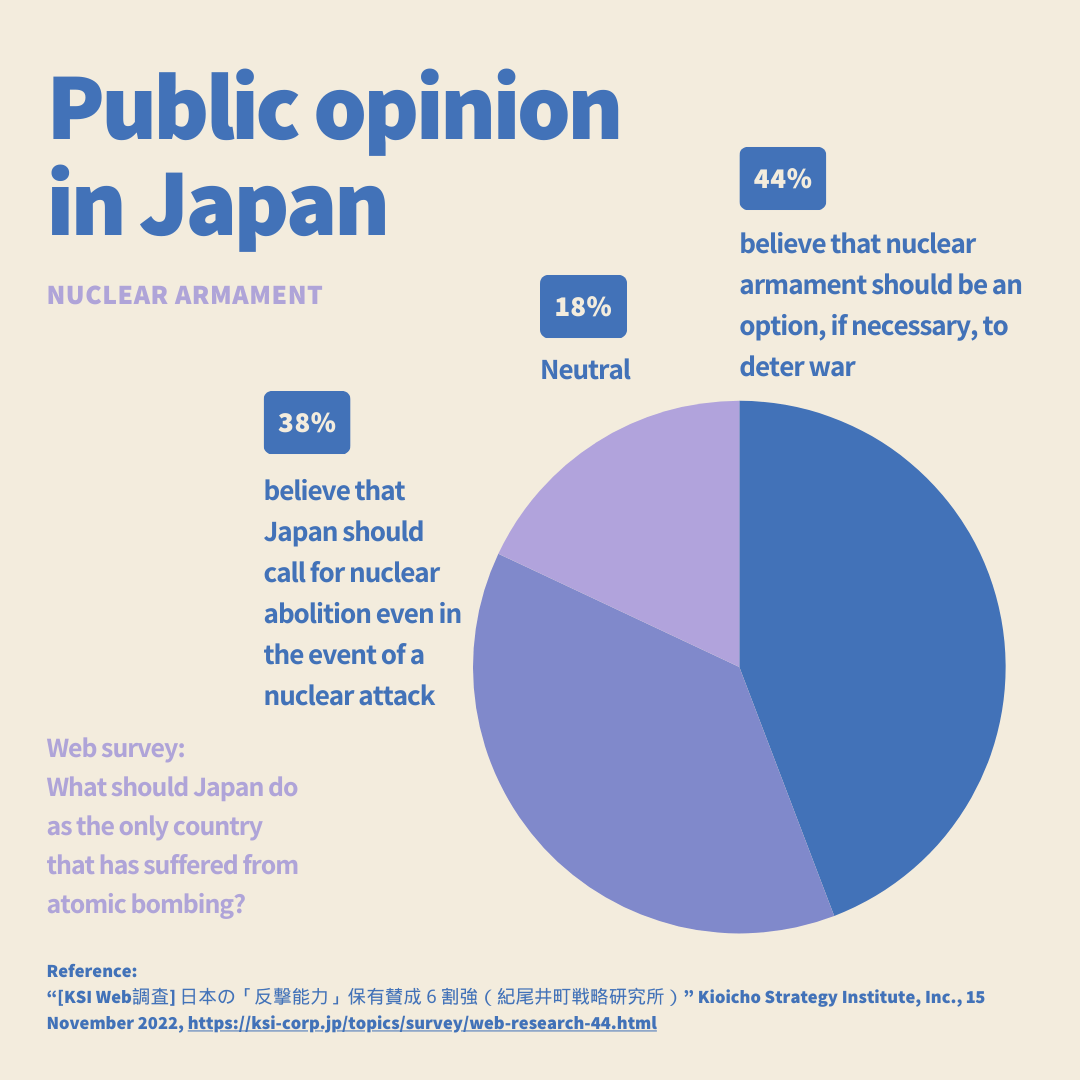
The pie chart is made by the author based on the results of a web-based survey conducted by Kioicho Strategy Institute, Inc.
As harsh as it may sound, the best way to prevent conflict might be to prepare for it. By engaging in discussions and actions focused on realistic defense strategies, including the potential for nuclear deterrence, we can ensure that Japan is prepared to protect its people if a crisis arises.
In conclusion, while the desire for peace is universal, we must remain realistic about the world we live in. Focusing on practical measures to defend our nation isn’t just sensible—it’s essential.

 Hirokitia
「The Fragile Peace: Japan’s Unseen Struggle」に2件のコメントがあります